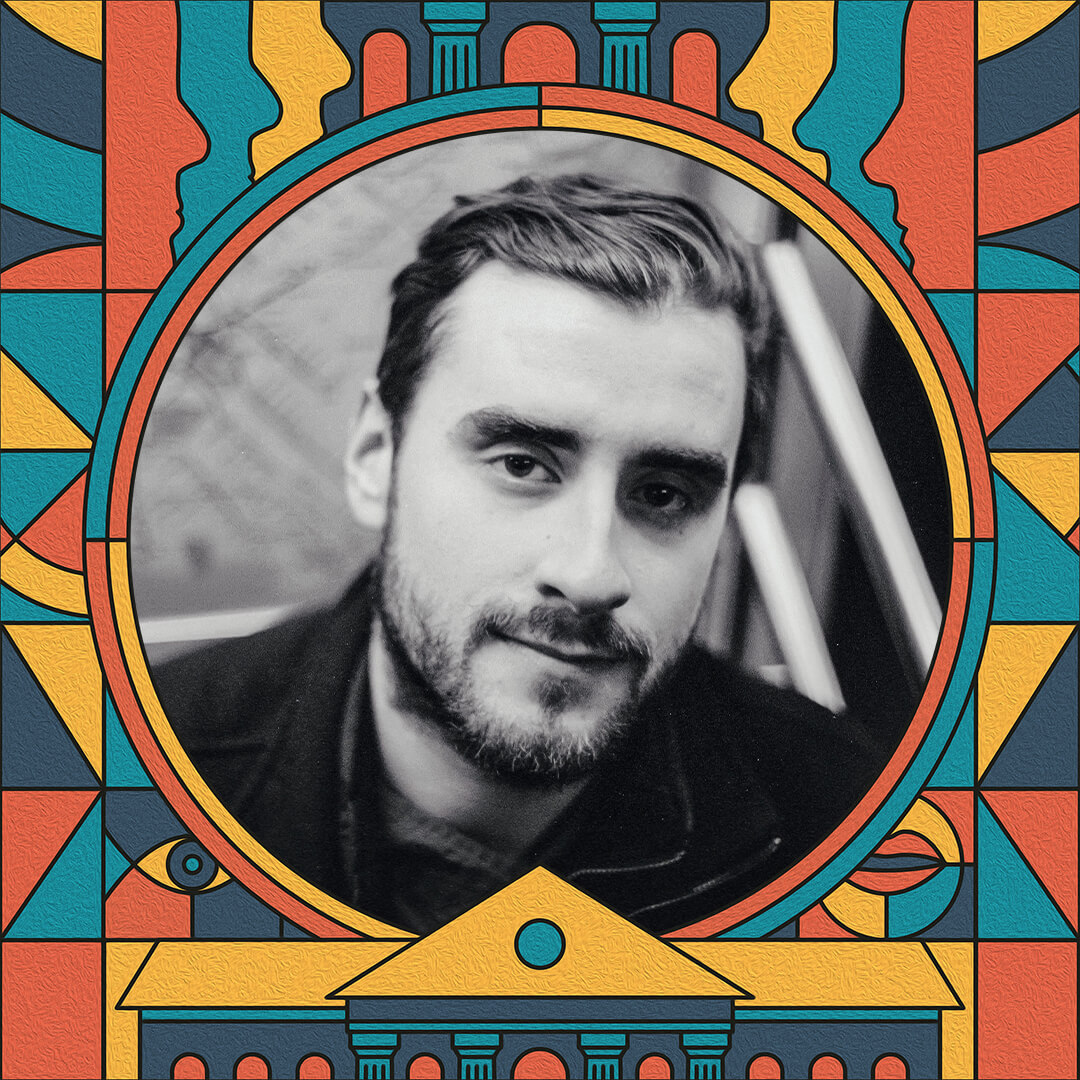
Abby: Matters of Experience is a project of Lorem Ipsum, an experience design company headquartered in New York City.
[Music]
Abby: Welcome to Matters of Experience, a podcast that explores the creativity, innovation and psychology driving designed experiences and encounters. If you’re new, hello and welcome. And to our regular listeners, thank you for tuning in again and supporting our conversation. My name is Abigail Honor.
Brenda: Hello everyone. This is Brenda Cowan.
Abby: So today we’re talking, Brenda, about venues that are designed exclusively to tell digital immersive stories. You know, I think they’ve evolved a lot recently out of the success of the multiple Van Gogh exhibits, and they’ve had significant success and love or hate what you saw when you got there, they’ve really created an opportunity which marketers, entrepreneurs, technologists, experience designers like me are really excited to reproduce in many different forms.
So today we’re chatting with Brian Allen, who oversees the creation and development of unique themed content, as well as architects state-of-the-art technological systems and frameworks. Co-founding Illuminarium, Brian designed and built multi-sensory immersive venues and content. Through his work producing Emmy Award and Cannes Lion-winning creations, virtual and augmented reality applications as well as location-based experiences, Brian has become a visionary in the world of immersive. Brian, welcome to the show.
Brian: Really happy to be here.
Brenda: Brian, you had a very unique upbringing. Can you tell us about your dad and how he introduced you to experiences?
Brian: My father was a set designer and a lighting designer, so at a very young age I was in a scenic shop. I was backstage in the theater constantly trying to figure out how things worked. And along these lines of experiences and seeing theatrical productions, seeing TV studios or being up in control booths, I was infinitely exposed to sort of how the sausage is made, so to speak, and it seems to have led me to my career and my drive to create and put on experiences for people, and that’s where I get the most joy.
Brenda: So, I’m really curious, Brian, something that you talk about is about how democratized the experiences are that you create. Can you tell us what you mean by that?
Brian: What we mean by democratizing experiences is not only access to experiences or accessibility of the experience, but I think it’s also about how you can be relatable to as many people as possible. It’s about giving people access and transporting people to places they may not be able to go or may not afford to go to. At Illuminarium, we used that tagline quite a bit, where we would put on shows that were revolving around a safari experience or a walk on the moon and create that emotion, create that memory for people to have a lasting effect.
Abby: So how did this whole technology side, you know, the digital side of the work come into your life, the dark side? When did that sort of like beckon?
Brian: It really started with photography and filmmaking, and I was immensely curious all the time. I took things apart. I learned how to work with my hands, which I think is crucial in this industry, in this business, and this sort of drive to understand how things worked. And after I graduated university, I ended up working at a production studio in New York called Radical Media.
And at that time we didn’t even use the word immersive. I think we called it experiential or experiential marketing, and brands would come to us with ideas and they didn’t want to just create commercials or TV spots or radio ads. They wanted experiences. They wanted a place where consumers could come and touch and feel and smell and interact with whatever product was being offered.
So, we started dreaming. We started dreaming really big. And if we didn’t know how to do something, we would just continue to research it. Trial and error, prototype things. And I think what it did more than teach me about technology was it taught me how to fail. And to me, that’s almost more important because technology is changing every single day, every single hour, and it’s almost more important to understand how to rapidly prototype something, and to get to the end product you have to go through many, many failures, you know, small and large. And so, I’m, it’s driven by this sort of endless curiosity about technology, experience, and creative.
Brenda: So, there’s a lot of human psychology in the work of advertising, connecting people with ideas and things through experiences and using emotion, curiosity, memory, these elements that you’ve been speaking about. What’s the overlap between your work in advertising and what it is that you’re doing here with these immersive environments?
Brian: You have to have this understanding of the human senses. You have to have the understanding of human emotion and how to sort of tease those things out by the way of pictures, video, lighting, scent, sound. You know, I think even before I was working in sort of immersive and location-based entertainment, we would always talk about, okay, well, what is this going to smell like?
What is this going to feel like? What happens when I walk up to it? And that’s really what’s going to drive your experience to the next level, bringing out as much of those thought-provoking, emotion-provoking elements within that experience.
Abby: Why do you think brands wanted to move into this area as opposed to stay where they were doing what they’re doing? Why is it such a powerful space to be in?
Brian: I think they’re beginning to realize that these things are much more powerful because I am physically there, I’m in-person, I’m with other people. It’s sort of a communal experience. It’s a shared experience. It’s something I can bring my partner or my friends to, and I can touch, I can feel, I can smell it. It’s sort of activating my senses beyond my sight and my hearing. That’s going to have a much more powerful impact to me than a 30-second spot.
Abby: So, when we talk about communal experiences, because I was just in a movie theater of all things, and despite loving being there with people, it’s often a double-edged sword. I’ll leave the listener to fill in the blank there.
Brenda: No, I want to hear more about this, Abby.
Abby: Let’s just say some people are about to have a fight. Some people kicking chairs, making too much noise. I was not involved with any of this raucous, but it was a little distracting from the film itself. So, how do you create successful communal experiences? Because I’m sure there’s some challenges.
Brian: To me, it’s all about setting the tone. We call it a palate cleanser. What is this sort of transitional space that’s going to allow you to sink in and be open to this experience? And I think of an experience if it’s powerful enough, if it has true spectacle within it, you’re able to kind of let things go, and you’re so in awe or so moved by what’s happening that you’re kind of, you know, maybe looking around and saying, did you just see that? Is it, are my eyes deceiving me? You have this sort of very emotional reaction with the people that you’re with, which is, in essence, sometimes more powerful than the creative itself.
Brenda: So, awe, as an experience, is pro-social. It’s really fascinating what happens with human beings when they are in nature, when they’re in something incredible like Illuminarium, the spaces that you create, it actually puts people in a perspective of wanting to, just like you were saying, have that did you just see that those experiences are very, very natural and you clearly tap into them beautifully.
Abby: I want to talk a little bit about Illuminarium. We’re talking about it sort of abstractly. Can you you know, just in a couple of words, Brian, describe its mission and what it’s trying to do.
Brian: Illuminarium is a projection based, immersive experience that plays out over two different spaces. At Illuminarium, we layer different technologies to sort of activate all of those senses. So, there’s a haptic system in the floor that generates low-frequency vibration. There’s a scent delivery system that every show has a signature scent. There is a spatial audio system that allows us to beamform audio, which, which essentially means I can place different sounds in the physical space without you having to wear any hardware or anything like that.
We sort of set out to almost give the illusion of reality to, to transport you to a different world, to a different environment. We also have an interactive system that’s sort of a person tracking system that allows us to activate or generate content depending on where you move in the space, which contrasted with maybe something like the Van Gogh experience, we sort of try to amp that up a little bit and use these various technologies on top of that to suspend your disbelief, right, to, to allow you to not realize that you’re in an air-conditioned building in Las Vegas or Atlanta. It was a really interesting format for us to work within. And I think it had challenges, right?
It’s really hard to have a beginning, middle, and end, a sort of linear narrative, when you can’t control someone’s attention. How can I have or convey a narrative, a storyline where there is, are characters and there’s things happening, no matter where I am in this space? I think it’s interesting from a storytelling standpoint in these types of formats, the sort of path that my mind goes down to take advantage of this opportunity is foundationally rooted in something like a Choose Your Own Adventure book.
I think about the use of interactive technology, the use of real-time technology, where it allows me to create content based off of somebody’s movement in real time. And that to me is really interesting because not only is it interactive, but it becomes personalized.
Brenda: Thinking about real-time and thinking about the nature of storytelling, I’m really curious to hear about the good old analog human being that you incorporate within the story. And I’m really curious if your people that you have in your experiences, are they storytellers themselves? Do you consider them storytellers or are they directional devices to help people follow the pattern and the flow? Are they scripted? Can you tell us a little bit more about how do you integrate in a seamless way a human being within this incredible technological spectacular?
Brian: So, there’s a smaller space in Illuminarium, and that’s where you meet your guide. And the guide is usually a human. So, another character of the story. So, in the space show, it’s an astronaut, and the human element is really important in that context because it sort of makes you feel connected to the content, right? So, you’re sort of like having this character break the fourth wall so that not everything is in the digital realm.
What we try and do is, you know, they have a script, but we often encourage these actors and actresses to add their own personal touch to these, these scripts. You know, there are certain things we have to hit, whether they be sort of, you know, rules and regulations. But even the rules and regulations are sort of branded within this story, right?
So, you know, don’t run and jump because there’s no gravity on the moon, which makes it a little more easier to hear and you almost start tricking people because they’re not necessarily hearing your safety procedures, but they’re being entered into this, into this story. You know, I view that person, that character, almost as this like shepherd through the narrative.
And I think it’s really important, no matter how digital and interactive and real-time, something becomes, you always have to have that sort of human element.
Abby: But is this now a beast you feel you have to satiate? Because it isn’t a museum or an institution linked to a specific mission. So how does this type of experience evolve, and who decides what’s next, what stories you’re going to tell, and how much is dictated by your, you know, your target audience and their interests?
Brian: In the first few experiences that we decided to create, we were thinking about experiences that had mass appeal. Experiences that worked in many different markets and that were timeless. It’s sort of akin to the early days of IMAX theater films where you have volcanoes and jungle and underwater, and they were saying, okay, we have this new camera technology, let’s just take it to someplace cool and push record, and we’ll see what we get.
And I think we’re in that sort of stage with this format where it is, you know, sort of in its infancy where how do we have an experience that is relatable to a lot of different age groups and different cultures, etc.? And then I look to sort of, okay, we’ve sort of done that and we have our sort of baseline experiences.
What I’m curious and interested in, is how do we take sort of existing IP that already maybe has a following, already has cultural significance, and create that world, you know, around the IP. So, I think of maybe the Stranger Things experience that was touring where they created an entire world out of a show or can I step into, you know, Picasso’s studio?
How do I sort of create those experiences, because I think they have a lot of emotion attached to them where people are experiencing this creative on one format that they’re really familiar with, and now they get to experience that in a format that they may have never seen before. But it’s this, it’s that sort of throughline of creative.
Abby: There’s a number of different companies, sort of like Illuminarium that are looking at monetizing this new immersive experience. And they’re looking at the square footage of the spaces, what’s ideal from that perspective and IP, is it worth the hundreds of thousands of dollars? You know, there’s a lot of unknowns, but a lot of potential on the flip side.
So, what do you think, Bryan, about the venue based immersion versus the traveling shows question, from a business perspective?
Brian: There’s pros and cons to each, right. So, I think the benefit of a traveling show is I can traverse many places in a short amount of time. I can set things up very quickly, and that could grow as a business, right? Cirque du Soleil has been doing it for years. You can have these very even technologically advanced and elaborate shows when you’re traveling.
The benefit of having a permanent location is you establish this brand presence, right? You have this facility, this place where people know if I go back to Illuminarium, I wonder what’s new, what’s playing next? Maybe that’s an event. Maybe that’s artists and DJs who are coming through town. We could host them Sometimes that was morning yoga sessions. Sometimes that was a new spectacle or a new addition to one of our spectacles. So you have this sort of evergreen nature to the, this sort of permanent aspect of that venue.
Brenda: I love the idea of how it is that this can by having these permanent sort of flagship places, if that’s the right word, can enable you to build community. I’m really curious about the nature of experience design writ large and how there’s so much of a journey of discovery going on right now. What excites you about what you see going on profession-wide and where you see our industry headed?
Brian: To me, what excites me are the people and companies who are trying to tackle the narrative question. We were talking about earlier how challenging it is to create narrative when you can’t control attention. How can I have someone come away from an hour long experience and felt like they just watched an Oscar winning film? The other thing that I am sort of really, really passionate about is the use of real-time and artificial intelligence systems to make things personalized, to make things evergreen, to allow this content to sort of change.
So, if I can have a single show that every time I come back, I not only leave an imprint of myself, but it’s a different show when I come back. And that to me is very, very interesting because it creates that sense of community, like you said, but it also has this sort of cultural center appeal to it, where I know that if I come back, I can, I can show someone, hey, that’s where I left last time this is, you know, whatever that is.
It’s a color palette. It’s a song. It’s a, you know, a character. That is interesting. How, how do we use these systems that are just now really coming to the mainstream culture when people talk about, you know, ChatGPT and DALL-E, those are interesting tools that we have as experience designers to now use within our creative.
Brenda: So, Brian, thinking about the visitor experience, what are the key differences between an object-rich venue designed for content compared with a space that has a more temporary digitally immersive experience inside of it? Do you think that not having physical exhibits or things to touch isn’t ideal, or is, you know, an equivalent kind of experience? How do you see objects and the lack of objects play into the nature of the connection that people are having with the story?
Brian: I think an experience that is object heavy or there is things to touch and interact with is always going to be my preference. I think that there is this grounded nature if I can touch things and and they have texture and they’re a part of the story versus something that’s purely digital, to me, I will always favor the first one. And I think if you’re going to have an experience that is leaning toward the digital side, you have to make up for it in story, in spectacle. But there is this, there’s the rooted connection of, you know, me being able to touch something.
I think back to one of the first sort of room scale VR experiences I ever did, which was put on by The Void. It was the sort of Ghostbusters experience where the digital world matched the physical world, but you couldn’t see that physical world. So, if there was a phone in the VR headset, there was a real phone that you could pick up. And I just remember being blown away by that because now you have this tool that you can texture and color your set however you want, but the object, the physical thing, the wind blowing, the, the smells, they’re all there, they’re all physical, which trick your brain into thinking whatever you saw on the screen was real. And that’s so important.
Abby: We have some listeners who want to know the brass tacks, like how much approximately does it cost to, like, create a space like Illuminarium, you know, and then to update it at all, because a lot of museums are, you know, they rely on donors and the government to keep open. And I know this is privately funded so quantify it for our listeners in some way.
Brian: So, I think there’s a spectrum to these things. And, you know, I think the I mean, let’s talk about the content creation. You know, you look at a blockbuster film cost $100 million or $200 million. We’re doing content for, you know, maybe 10% of that. And I think there’s still a spectrum between that where, you know, you don’t have to have these $10, $20, $30, $40 million budgets to create great content.
It is very expensive and the reason it’s very expensive is because of the sheer amount of real estate you have on your screen, right? So, that increases things like rendering costs, it increases capture costs, post-production, VFX work. Now, in terms of infrastructure, that’s totally scalable, right? You can do something on the Van Gogh side for $2, $3, $4 or $5 million and be able to travel that.
And sort of on the permanent scale side, you know, that’s, you know, in the realms of $10, $20, $30 million. It’s that classic, you know, audiophile question of well how much money do you have, how much do you want to spend? And then there’s a baseline. No matter how much technology you have and what projectors you have or whatnot, it’s always going to boil down to the content. It’s always going to boil down to how good is your story, how good is your narrative, and what do people feel when they come away.
Abby: Brian, thanks so much for joining us today and sharing your thoughts on successful, technologically advanced experiences and reminding us how important a human is at the center of those.
Brenda: And the story, Abby, right? Brian, thank you so much. This was amazing. We really appreciate your time.
Brian: Thank you very much to you both. It was fantastic speaking with you. And I really appreciate your time.
Abby: If you like what you heard today, subscribe for more episodes of Matters of Experience wherever you listen to podcasts and make sure to leave a rating and a review and share with a friend. We’ll see you next time.
Brenda: Bye bye, everyone.
[Music]
Producer: Matters of Experience is produced by Lorem Ipsum Corp and recorded at Hangar Studios. Tune in next time for more fun discussions about experience design.