[Music]
Abby: Welcome to Matters of Experience, a podcast that explores the creativity, psychology and innovation driving designed experiences. A big, hearty welcome to everyone listening. My name is Abigail Honor.
Brenda: Hello, everyone. This is Brenda Cowan.
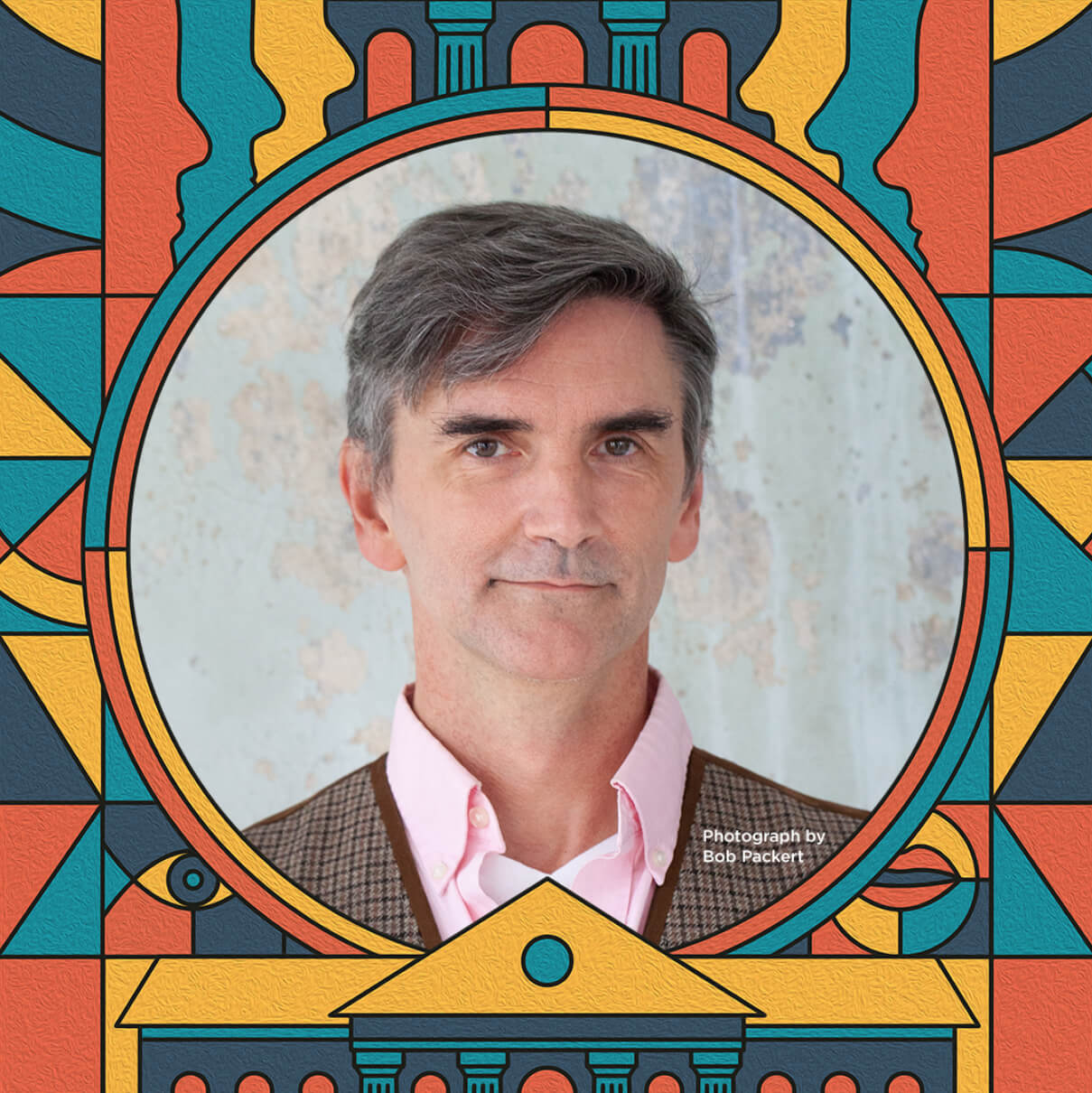
Abby: Today, we’re talking with Ed Rodley, an award winning experience designer who’s worked for over 25 years creating visitor focused projects for science, natural history and art museums, just to name a few. He’s co-founder and principal at The Experien–– ce Alchemists, an experience design firm serving cultural organizations both large and small. Prior to that, Ed was Associate Director of Integrated Media at the Peabody Essex Museum. He is a passionate believer in what Ed refers to as the informal learning that is at the heart of the visitor experience, which I’m really keen to hear more about today. Ed, welcome to the show.
Ed: Thank you so much for having me, Abby and Brenda.
Brenda: Ed, you began museums as an 11 year old volunteer, not very long ago. And over the years, you’ve done every front-of-house position possible. What first attracted you to museums and what were some of those first really critical jobs?
Ed: Oh, boy. I think probably the first thing that attracted me to museums was that museums offered to take me in, right, so when I when I started at the impossibly young age that you mentioned, there was a program being run by the Museum of Science in Boston where I grew up, where they would invite middle school students to come in and lead tours. Basically, we would walk kindergartners around the museum and read the labels to them. So, the reason that I got interested was not because I had a burning interest at age 11 in museums, but because the museum asked like, please come in. And once in, then obviously the hook was set, as it were. And I proceeded through, as you said, a lot of front-of-house jobs.I was a guard, I was a ticket taker. I worked in, you know, putting sharks’ teeth in bags in the store.
I didn’t even really think about museums as a career option until after college, even though by that time I’d been working in museums for over a decade. It’s as simple as just meeting the right person, which in my case was having lunch with the woman who was in charge of traveling exhibitions at the museum, who was complaining about how overworked and understaffed she was. And it was only really at that point at age, you know, whatever, 24, 25, that the light bulb went on in my head like, oh, wait a minute, people make the things that the museum is full of that people come to see. And that could be a job you could do, instead of being a ticket taker, like, huh, interesting.
Abby: And in terms of sort of the importance of a mentor, can you talk to us about how she mentored you?
Ed: I did not realize the great good fortune I had when I first got my first job in exhibits. The woman who hired me was of that generation of women who’d come up in museums when if you wanted to get ahead, you were basically either going to work in personnel or you were going to be like the executive secretary to the director. So, the idea that you could become a manager in your own right and have some power and authority was something that she had managed to achieve, I think pretty much through sheer dint of personality.
And she was determined that the next generation was not going to go through what she went through. So from the very, from the very get go, she really inculcated in me part of my responsibility as professional was to actually leave the profession better than I found it, which at the time I thought was just what bosses did. It seemed like a very logical boss thing, right? Oh, you’re going to set parameters for me and give me something inspirational to aspire to. And it was only after I had stopped working for her and had many other bosses that I was like, oh, oh, she was a mentor, and all these other ones are really just bosses.
Brenda: Man, I’ve got to say, I had a very similar story to yours where my very first boss, who is at Brooklyn Children’s Museum, all honest, he changed my life. And I knew at the ripe old age of 22 that museums were going to be the rest of my life. So, how is it that you went from there to where it is that you are today?
Ed: The usual, very non-linear path, I guess you could say. I gradually moved over the next many years into doing content development and exhibit development. And one of the shows that I worked on in the mid-nineties was a tiny little exhibit just trying to explain what the World Wide Web was, because I thought this is an interesting thing and it was a brand new technology at the time.
So, then I became the quote unquote computer guy, and that led me into thinking about digital engagement and that interest in the digital and particularly in the intersection of the digital and the physical is a thing that has just stayed with me ever since. And so that was, that was part of the motivation for moving into art museums, because strangely enough, they have much deeper experience thinking digitally than a lot of other museums because they were among the first crop in the sixties to really embrace what they called data processing back in the day.
That led up to the pandemic, and lots of people, including myself, losing their jobs and deciding that, well, you know, in the middle of a pandemic, this is a great time to start an experience design firm and try to do this kind of work for not just museums, but other kinds of clients as well.
Abby: Tell us about some of your adventures, like at Skywalker Ranch. You know, what was that like? Sorry, I love Star Wars, I’m not going to miss this opportunity.
Ed: You’re really just going to drag me into the mud on this thing.
Abby: I know, I totally am.
Ed: 11 years old, Star Wars. Okay. So, one of the other things I did at a very young age was ditch school one fine May day in 1977 to go see a movie that was playing at the, the biggest theater in Boston at the time, which was called Star Wars. And that began a lifelong love of the, of the movies and of the people who made them. One of the highlights of my career was we actually put together a proposal to do an exhibition that used Star Wars as a way to think about and look at new technologies that might be coming in the real world.
We would often run into the problem at the Museum of Science, where we would be thinking about how do you get people to visualize something that doesn’t exist yet, right, because your vision of the future and my vision of the future are probably going to look wildly different so there’s no common frame of reference. Really, without that kind of scaffolding, it’s hard to get people to move where you want them to. So, if we wanted to talk about cryogenically cooled superconducting magnetically levitated trains, right, that doesn’t mean anything to you, probably. If I say like, land speeder, people immediately have an image of what that is.
Abby: Oh, yeah.
Ed: And so we proposed to Lucasfilm that we use Star Wars, really not for Star Wars’ sake, but just as sort of a shorthand to get us to talk about stuff in the real world. This take was different enough that George was actually interested enough to say like, you know, sure, go ahead. Go work with these guys. So I did find myself in the situation of being a lifelong Star Wars dork, like driving up to the unmarked front gate of Skywalker Ranch to go talk to people at both Lucasfilm and Industrial Light & Magic and Skywalker Sound, and actually meeting the people who had made the things that had entranced me as a teenager back in 1977. And interestingly, with all of the real-world scientists and engineers we talked with, there were between them almost a universal similarity in that they’d all had that kind of experience with something, usually a pop culture reference. It might not have been Star Wars per se, but like you could almost, you could rank roboticists by were they the crop of people who went into robotics because they saw 2001: A Space Odyssey or because they saw Star Wars, which was fascinating.
Abby: I was going to say it’s fun when, you know, obviously you often have art imitating nature, but in this case, nature imitating art. And a lso that awesome use of a common language, using Star Wars to tell what were probably quite complex concepts and information is really awesome, and I think when designing museums, it’s a great example of sort of thinking differently, thinking outside the box, thinking about a different way to represent information that can connect with your visitors.–
Ed: Yes.
Brenda: Well, I’d like to bring us a few light years forward to present day. I know I’m hilarious. Right? As you’ve expanded over the years, you’ve observed that the visitor experience was not really very holistic. Has it changed since COVID? How have you helped make things more holistic for visitors and their experiences through some of your recent work?
Ed: One of my strange pet peeves as somebody who spent most of his professional life working in making exhibitions has always been how much less focus gets paid to everything that happens outside of the gallery doors, in museums in particular. The idea that the visit, quote unquote, to a museum is only the part that happens when you’re in the galleries where the stuff is, is really just not the way that people experience museums, right?
The visit is everything. The visit is deciding to go. It’s getting there. It’s parking, it’s walking through the front doors. It’s trying to decide what kind of ticket to buy. All of these things make or break the visit as much, if not more, than the actual content, which is kind of a difficult pill to swallow for somebody who’s interested in making the content.
I’m sure we’ve probably all had the experience of being at a cultural organization with somebody who didn’t want to be there, right? And they are the people who usually drive that experience because the least interested person is the person who’s going to decide when the group leaves. For me, experience design was a very neat way to take that desire to think more holistically about the work the museum does, and also frame it as a way that it was something that I could be part of.
You know, in my, my earliest days working in an exhibits department, you know, well the lobby, that’s not your business, that’s visitor services or the membership desk, you know, that’s not your business, that’s membership’s business. And the hallways belong to security and the garage belongs to the garage. And, you know, for visitors, they don’t make any of that fine distinction. It’s all the museum to them. And for us to take the mental model of the org chart and try to apply that to the visit is just really not helpful.
Abby: Yes. So you started to talk to us a little bit Ed about when you became a digital guy. From your perspective now, what does digital bring to the visitor experience in institutions, good and bad?
Ed: One of the things I think is the agency equation is much more sharply slanted in the visitor’s favor just because if it’s a thing that’s happening on your phone or some kind of device that is yours, you can put it down or you can turn it off or you can stick it in your pocket or your purse. Digital gives you at least the possibility of being much more selective about when you actually are trying to push stuff toward the visitor or when you’re asking them, when you’re using the pull mechanism of like, tell us what you want, and we’ll give it to you when you want it.
The example that I use to try to explain this is one from a museum I went to in Australia called the Museum of Old and New Art. It’s this absolutely crazy private museum in Hobart, Tasmania, literally the bottom of the planet, built by this internet gambling millionaire who amassed a giant collection and built this strange museum. And his whole organizational scheme was he loved art and he hated art museums and he didn’t want to make a museum that looked like a museum.
So, there’s no labels. Zero. All of the interpretation happens via a mobile device. And if you want to learn anything about any of the art, you have to actually look for it and seek it yourself rather than having it just pushed at you. And I wound up having probably one of the most transformative art museum experiences I’ve had because I didn’t have to have anything interfere with the visit that I didn’t want to have interfere with the visit.
There was a particular moment where I was standing in front of a painting and I was looking at it and thinking like, this looks kind of like a crappy Picasso. And having the realization that, like, I don’t like this painting and I look it up, and of course it is a Picasso. And if there had been a tombstone label there that said, you know, Picasso, Pablo, Spanish, active in France, 18, blah, blah, blah to 19, blah, blah, blah, I probably would not have had the ability to have that realization that I didn’t like this piece because everybody ==y knows Picasso is part of the Western art canon.
He’s, he’s a single name artist. Like, you can’t not like him, in the same way that I could like this thing that I had a direct encounter with without any kind of mediation, right, and that was a very important moment for me, just realizing like, oh, yeah, if you put these things out there like labels where everybody can see them all the time, even if you don’t look at them, they still affect your visit.
Brenda: I’d like to talk about really some of the work that you are, I believe, the most well-known for, which is digital immersion. So, you see immersion as the beginning of an experience, not the end all, be all of an exhibition experience or an environmental designed experience. So, build spaces like Meow Wolf or large scale digital environments that integrate built environment with VR and digital technologies.
These are spaces that you see as being rich with potential for visitors to engage deeply into content. Can you give us an example of the best that you’ve experienced so far? Like, what should we all be aiming for?
Ed: Well, one thing I would say is the, the one size fits all solution doesn’t exist. In terms of what makes a successful immersive experience. If you look at and I’m going to say a lot about immersive Van Gogh, which is not to say that I’m going to rain all over immersive Van Gogh, but they are useful exemplar because everybody has heard about it if they haven’t actually seen one of them.
If you go all the way back to the 1990s and people like Janet Murray in Hamlet on the Holodeck, she points out that the word immersion originally had a very specific meaning. The word immersion meant being dunked in water, like jumping into a pool, being baptized, going for a swim, and it’s that sensation of transitioning from one environment to another environment that is radically different enough that you are completely aware of the transition.
So, if you think of the moment after you’ve jumped in the pool, you become intensely aware of that environment and you’re trying to figure out, okay, how do I survive in this environment? In digital immersive environments, that same thing is happening, right? Normally in our default world, stuff isn’t moving on the floors and on the walls and on the ceiling, so when you leave the default world to enter one of these like immersive Van Gogh experiences, your brain does sort of the same thing. You’re trying to figure out like, okay, what are the new rules that apply here? The thing about immersive Van Gogh, that’s sort of a lost opportunity for most of them, I think is eventually that new environment becomes your default environment, right?-=
The immersion basically gives you a very short time span when people are really paying attention and therefore it becomes an opportunity for you to be able to leverage them to do anything else you want. But once that immersion effect wears off, oftentimes that will be the end. If there’s nothing else there, that’s why people get up, they go, okay, big pictures on the walls and ceiling, I get it. And they leave.
Brenda: Yeah, it’s all about the potential, and like you said, the missed opportunity.
Ed: Yeah. The Mexican director, Alejandro Iñárritu, created a VR experience a few years ago called CARNE y ARENA, which was ostensibly a VR experience designed to help people understand what it’s like to be a migrant trying to cross the southern border into the US. But it is actually something that manages to hit almost all of the necessary elements I think you need to have in order to particularly leverage the immersion aspect of what makes an engaging digital experience.
You go into a fairly industrial looking space where you have to take off your shoes and you get a little bit of onboarding about what’s going to happen to you. After you get your training, you get dumped into the center of the experience, which is basically a giant sandbox, literally, like it’s a large empty space with sand on the floor.
They have heat lamps going, so you have the goggles on at this point and you’re seeing a VR film of nighttime in the U.S. South somewhere, and there’s a group of migrants walking along in the dark and they have an encounter with the Border Patrol. You’re getting all of the immersion, you’re getting it reinforced kinesthetically, right? Your feet are actually crunching on sand. Your skin feels warm. And the story of what is happening to these people really takes that immersion and makes this thing an intensely emotionally evocative experience.
And at the end of all of this, there is actually a third space after that that is sort of like a traditional museum gallery where there are pictures of the actors who were in the thing that you just witnessed. Many, I think if not all of them, are actual migrants themselves, and they do a really, I think, delightful job of off boarding you. Right. Because one of the things that we know from psychology is that for intensely emotional experiences, you need time to process it. So, when the, when the learning actually happens is not when you’re experiencing it, it’s when you’re reflecting on that experience, like what just happened.
So, yes, it is an immersive experience, but it is really so much more than an immersive experience. And to shorten it down to just calling it immersive is kind of a disservice to what it’s trying to do.
Abby: It’s interesting the example you just gave, Ed, when I’m thinking about back to the idea of education versus entertainment discussion, I think back to one of my favorite teachers who brought history to life in school in such a really, truly entertaining way that I’ve still managed to remember some of the things he’s taught me to this very day, which is a kind of like small feat because I’ve forgotten almost everything I learned at school.
So for me, when I visit a museum like the Tenement Museum, we were talking to Annie Polland recently, you know, I’m learning, being immersed but also being entertained, it really sort of captured my imagination. So I just wanted to sort of get your thoughts on that balance.
Ed: So, one of the things that has been helpful to me has been to think about the visitor experience as someone who creates the experiences as being in sort of a host guest relationship. The most important thing I think an institution can do is display hospitality, which is getting at sort of your idea about comfort, right? What do you need to do as a good host to be hospitable for the people who are visiting you?
You need to make them feel comfortable. You need to tell them where the bathroom is in case they need to go to the bathroom. If they’re hungry, you need to feed them. And if there are other things going on, it’s really your job for them to have as successful an experience as possible. For me personally, is getting people to think of their audience not as demographic segments but as real people.
It’s very easy to talk about demographics, but it’s also very easy to decide to give up on demographics, where it’s much harder to do that to people. You can say like, Oh, well, you know, Spanish labels are too hard. We’re just not going to do it. But if you actually have a face or even, you know, just a user persona of an actual person representing this group, it’s a lot harder for people to be inhospitable.
And for me, that is sort of the thing I come back to all the time. Hospitality. What does it mean to lay out the welcome mat for people.
Brenda: So let’s talk about your work as an exhibition planner and as an experience planner. You’re a big believer in not being too precious and in doing things such as testing or formative evaluation, prototyping, recrafting. You’ve said that it can be freeing, and I know that from a designer perspective, this can take a lot of humility and a lot of willingness to let go, and that’s pretty tough stuff sometimes.
What are some of your experiences? Do you have any examples to share?
Ed: Certainly the first time I ever sat down with an interactive that I had worked on to watch visitors try unsuccessfully to use it is the kind of humbling experience I think everybody should have the opportunity to have. There’s nothing worse than sitting there with your clipboard watching people just, you know, trying again and again and again to do the thing that they’re trying to do and failing. Being able to take that and say like, okay, that’s not their problem.
That’s my problem. Like, I designed this thing wrong and we need to go back because I don’t want anyone to have the experience ever again. Having watched it. That’s the thing that can end somebody’s visit, right? You get one of these experiences where you’re, you’re trying and you’re trying and it’s just not working. And many, many times people will reflect it back on themselves because they have such great trust in cultural organizations. Like, the thought won’t even occur to many people that like, maybe it’s just a bad design. They will think, I’m stupid, I can’t figure this out.
Abby: I think, you’re talking about instinctive design, I think you’re, you’re dead right to be honest, when we’re designing interactives, it has to be familiar. I mean, we’re all using them all the time. There’s no need to reinvent the wheel. And when we had a podcast with Sina Bahram who came on to talk about accessibility, and when you think about layering that on top as well and expectations for those visitors, has to be intuitive, has to be simple.
The design needs to be accessible for everybody. And I think it’s really interesting you mentioned ego, we also have a podcast on ego. I love that idea of interviewing for resiliency because you do, you’re right Ed, you have to be comfortable seeing your work changed by clients, changed by the team, and I think it’s definitely a tough early lesson for, for designers.
Ed: It’s not even an early lesson, I mean, there are, there’s still plenty of room for plenty of people to learn that lesson. When the Star Wars exhibition was finishing its ten year long intercontinental cruise around the planet, a couple of the people who had worked on the show, we’d all moved on by then, but somebody had said like, you know, Star Wars is wrapping up at its last venue in San Jose.
We should go see it on its last day. Three of us decided we were going to fly across the country and we went to see the exhibition on its very last day. And there was something very, very powerful about being there with something that you had brought into the world, seeing it out again on the way. And the very next day, you know, friends who were working at the museum sent me pictures on my phone of like the first load going into the dumpster. I was like, there’s 15 years of my career in the dumpster and, and, and that’s okay.
Abby: Wow. That is the best therapy, I think talking about letting go and ego or in this case, fear of the unknown. I want to turn our focus to AI, and how some of our tasks are being taken over by it. And that’s clearly unnerving for a whole lot of people, a whole lot of creative people, I’m thinking about writers, who are worried their jobs could be over. So, Ed, how do you feel about AI and do you think it’ll disturb the museum experience?
Ed: Whoa.
Abby: I know, I’m sorry.
Brenda: In five words or less. You may not use a chat to answer this question.
Ed: I’m going to take a big, long drink first. I’ve lived through enough technology trends to recognize the truth of the Gartner hype cycle. You guys familiar?
Brenda: No.
Ed: So Gartner, in their market research, realized that with technology trends, there tends to be this sort of parabolic curve that technologies follow where, at the top of that, that parabola, you know, everybody saying it’s going to change everything. And it’s the be all it’s all like, imagine, you know, VR for the last 20 years and then it gets to a point where it stops being novel and interesting and goes down the other way and sort of plummets to like, this is stupid.
It’s not living up to any of the hype. And then eventually it comes back up again to whatever place it really is meant to have in society. And with AI, clearly you’re seeing something that’s at the very top of its hype cycle. But we saw the same thing happen, I mean, I’m going to date myself now, although I already have, you know, computers and exhibits.
Are they going to ruin everything? Yes. Well, maybe not. Yeah, they’re kind of ruining everything. No, they’re just part of the, part of the tool kit that we use now and AI, I’m pretty sure is going to follow the same path. Is it going to put some people out of work? Definitely. I mean, every, every new technology has that kind of disruptive effect.
Abby: Mm hmm.
Brenda: Ed, we want to take a last opportunity to just ask you to tell us about the book that you are currently working on.
Ed: Thank you very much for the opportunity. I have been working for several years on a book on museum experience design that it currently has the working title Designing for Playful Engagement, and it is really an attempt to try to put a sort of a theoretical underpinning under the last 30 odd years of everything I’ve been doing, an opportunity to sort of walk people through what we actually know about how human beings engage with cultural experiences.
In terms of both the museum literature but also the scientific literature as a way, particularly around these new technologies, to not get stuck in the hype cycle, but really try to get into like what does neuroscience and psychology tell us about the usefulness of people being able to experience their emotions comfortably and who are, who are people out there who have done interesting things you can look at because we know museum people love case studies.
Abby: Thank you so much for joining us today, Ed, and sharing your quite candid answers to our pretty big, weighty questions and also for introducing Star Wars finally into one of our episodes. I’m really looking forward to reading your book since playful experiences and creating places to be emotional is so integral to our work, our design work at Loren Ipsum, so really looking forward to reading your book. Thank you.
Brenda: Sounds like a good one for my students as well. Godspeed, Ed. Thank you so much for joining us.
Ed: Thank you for having me. Being in the same company as people like Annie Polland and Sina, I feel like I’ve made the big times.
Abby: You’ve made it.
Brenda: You have.
Abby: And thanks to everyone who tuned in. If you like what you heard, subscribe to more episodes of Matters of Experience wherever you listen to podcasts. Make sure to leave a rating and a review and share with a friend. We’ll see you next time.
[Music]
Producer: Matters of Experience is produced by Lorem Ipsum Corp and recorded at Hangar Studios. Tune in next time for more fun discussions about experience design.