If you’ve ever ridden an elevator, zipped a jacket, watched IMAX, or tapped a touchscreen, you’ve experienced the legacy of a World’s Fair—whether you knew it or not. In this episode of Matters of Experience, hosts Abby and Brenda Cowan welcome Charles Pappas, one of the world’s leading authorities on World Expos, to uncover how these massive, temporary gatherings quietly shaped everyday life. From the Crystal Palace of 1851 London to Dubai, Osaka, and beyond, Charles traces the evolution of World’s Fairs through what he calls three eras: products, progress, and panic. Along the way, he reveals how expos introduced groundbreaking technologies, redefined optimism during global crises, and now confront urgent environmental challenges. The conversation explores why these events function as powerful engines of cultural exchange, national identity, and human connection—something no digital platform can fully replace. With vivid stories about iconic monuments like the Eiffel Tower, immersive pavilion design, and moments of pure serendipity, this episode is a love letter to shared, in-person experience—and a compelling argument for why the World Expo still matters today.
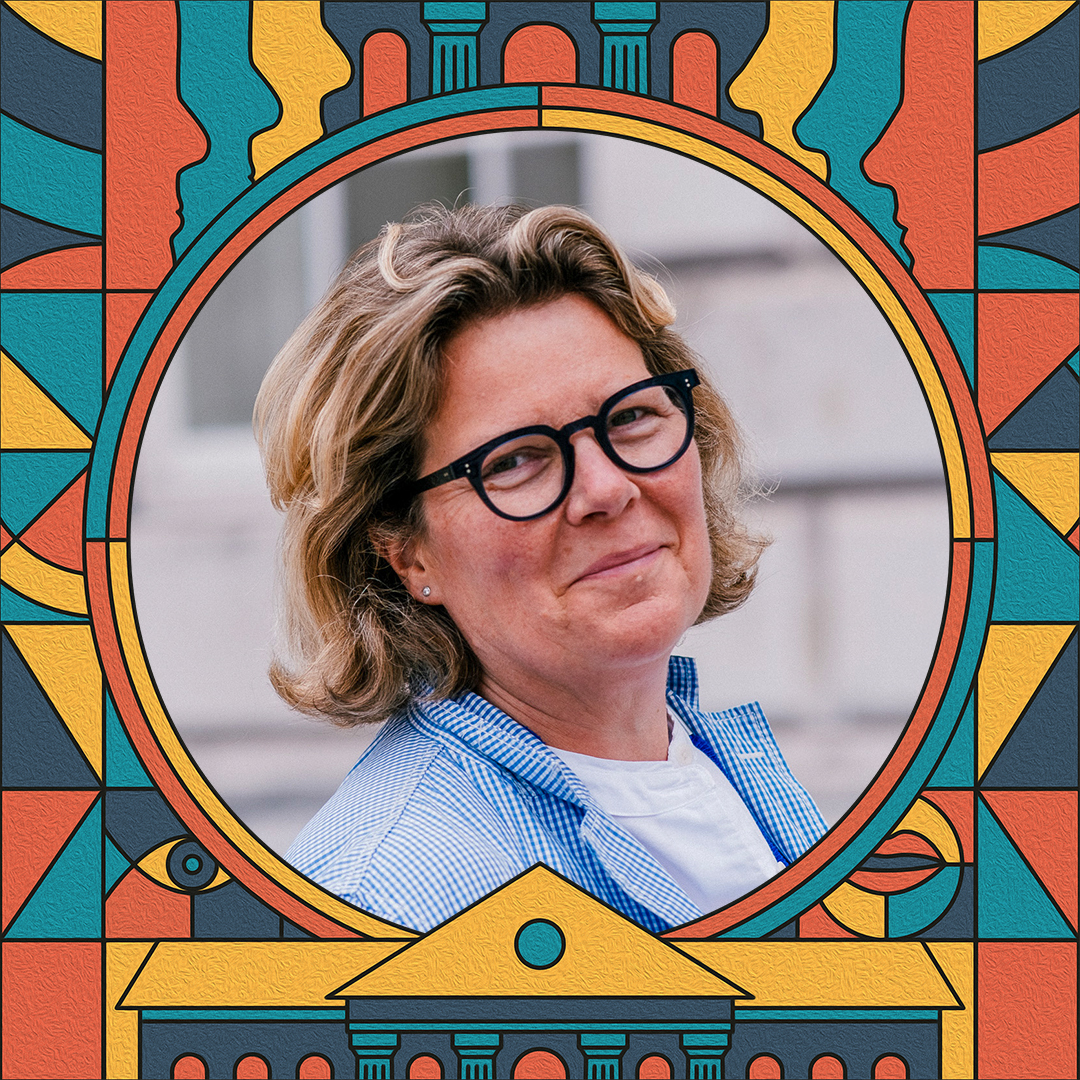
The Invisible Music of Museums
Designer and creative leader Lucy Holmes traces a life shaped by letters and by people. From hand drawing alphabets at RISD to orchestrating typographic rhythm through major museums, she reveals how the most resonant design often disappears so visitors can be fully with the work. Holmes describes turning words upside down to see relationships rather than read them, printing and pinning, tracing and testing, until a single word on a wall feels inevitable. Designing permanent galleries means thinking in decades, choosing people and stories over brittle technology. The result is quiet clarity, composed for the present and built to meet the future.
About Lucy Holmes
Transcript
00:00:00:00 - 00:00:29:10
Abigail Honor
Welcome to Matters of Experience, the podcast where we dive into the ideas, innovations and imagination shaping the world of designed experiences, from museums to multimedia. From architecture to AI, we explore how creativity transforms space into story. If you’re joining us for the first time, we’re so glad you’re here. And to our regular listeners, thank you for coming back and being part of the conversation.
00:00:29:14 - 00:00:38:15
Abigail Honor
If you enjoy what you hear today, please take a moment to rate the show and share with a friend. It helps curious minds find us. So welcome I’m Abigail Honore.
00:00:38:17 - 00:00:40:19
Brenda Cowan
Hello, everyone, this is Brenda Cowan.
00:00:40:21 - 00:01:08:24
Abigail Honor
Today’s episode is a conversation with Lucy Holmes, founder of Home Studio in London. She is a designer and creative leader who has spent over 30 years working with the arts and cultural sector. Lucy is no stranger to the US because she started her design journey at risk. For those who aren’t familiar with that, it’s Rhode Island School of Design, where she fell in love with graphic design as a way of seeing things as a way of life.
00:01:09:03 - 00:01:31:20
Abigail Honor
She moved back to Old Blighty and after working at some top companies like pentagram, she made the fearless moved to set up her own company. Are lots of things to talk about that with you, Lucy putting people at the heart of her thinking. Her recent projects include working with the Fitzwilliam Museum in Cambridge, the Natural History Museum of Denmark, the Science Museum London, the London Museum and the British Museum.
00:01:31:20 - 00:01:57:19
Abigail Honor
So basically, if you’re headed to London for fun or professionally and wander into a museum, chances are it’s one of hers. She’s also a multiple award winner from professional bodies including daddy DBA, Estee and SGD. And I’m not going to spell out all of those look them up, but she’s a fellow of the Royal Society of Arts, which for everyone who doesn’t know, makes a very special.
00:01:57:21 - 00:01:59:21
Abigail Honor
Lucy, welcome to the show.
00:01:59:23 - 00:02:07:06
Lucy Holmes
Well, thank you very much for having me. It’s, it’s very nice to be here and to have the opportunity to talk to you both.
00:02:07:08 - 00:02:29:09
Abigail Honor
So, Lucy, you and I were introduced by Sybil Jones, who a lot of people know is the CEO of SGD and enjoying a lunch at the River cafe designed by Richard Rogers. I know one of your one of your favorites who sort of designed a lot of that Thames Wharf there. And you told me this lovely story about being at school, studying and that sort of light bulb moment when you fell in love with typography.
00:02:29:14 - 00:02:43:23
Abigail Honor
Can you tell us about this passion? You know how it started off from sort of leading you to the Guardian story? Because I think what resonated with me is passion that we have as designers for sometimes everyday things, and how they can be elevated to art.
00:02:44:00 - 00:03:15:07
Lucy Holmes
At the time, you know, the different disciplines within what we do weren’t really given names. If you weren’t going to be an artist, you were kind of a bit lost. And I was very interested in typography. Weirdly, as someone who’s dyslexic, maybe I had to scrutinize letters more than other people. But studying typography at Risd, where we were hand drawing letters and we were and hand drawing alphabets and then sentences and really understanding the relationship between one letter and another.
00:03:15:09 - 00:03:41:11
Lucy Holmes
And it wasn’t formulaic. It was artistic. You know, an e in the domi to a T, is an upper and lower case. It’s every single formula was a different problem to kind of solve and understand. One of our teachers, a guy called Doug Scott, who worked at WGBH in Boston, had come back from London with the new redesign at the Guardian in 1988 by David Hillman from pentagram.
00:03:41:13 - 00:04:07:03
Lucy Holmes
And we were looking at full pages of letters, and I realized that actually with white or off white paper and black letters, you were creating these sort of compositions of gray with the motivation of legibility, energy, pace, on a broad sheet. And that, for me, was the moment where I thought, this is what I meant to do.
00:04:07:03 - 00:04:11:05
Lucy Holmes
And this is what I love. So it kind of grew. Everything’s grown from that.
00:04:11:07 - 00:04:40:05
Brenda Cowan
I love hearing about your experience with working with your hands in my design program. That fit, we have students developing ideas and doing design work by hand as well. We do a lot of hand sketching, prototype building with paper and tape, basically getting off the computer as much as possible. And what I find is that designers are freer in their thinking, maybe more willing to iterate at times, maybe more willing to make mistakes.
00:04:40:10 - 00:05:02:01
Brenda Cowan
And mostly I find that working with our hands enables us to reach certain insights. And it sounds like that was perhaps part of your experience. You know, when you kind of skip these days straight ahead to digital tools, you can lose that tactile feedback that you get and that sort of ability to mess around with trial and error.
00:05:02:07 - 00:05:16:15
Brenda Cowan
Can you tell us a little bit more about working with your hands with type? Is this something that you still do? Do you or do the folks who you work with, do they still work with their hands? Do you still do hand sketching? What is that part of the process look like?
00:05:16:17 - 00:05:24:19
Lucy Holmes
Yeah, I mean often I mean, I’ve got tracing paper, on my desk in front of me where I’ve been sketching with a Sharpie.
00:05:24:21 - 00:05:25:16
Brenda Cowan
Perfect.
00:05:25:17 - 00:05:39:00
Lucy Holmes
We we do draw. We often get out rolls of of tracing paper. Sometimes it’s drawing directly onto an iPad. But I think for myself and the team, it’s a place where we’re free.
00:05:39:03 - 00:05:40:03
Brenda Cowan
Yeah, we of.
00:05:40:03 - 00:06:06:00
Lucy Holmes
Course, at this point in our careers where we’re well, versed in using the technology. And I think particularly when we’re working with either one word or a collection of letters in a museum project that I will always print things out, turn them upside down, stick them on the wall, because it’s just it’s more difficult than anything is to put one letter or one one word on a wall in a museum is one of the most frightening things.
00:06:06:02 - 00:06:20:10
Lucy Holmes
And, you know, the relationship between those letters and how that’s made. And if the letters you’re going to be lit or if they’re going to be three dimensional, you know, every single thing changes that dynamic and the relationship between those letters.
00:06:20:12 - 00:06:24:21
Abigail Honor
Can you just explain why you turn upside down to folks who may may not know why you do that?
00:06:25:02 - 00:06:49:06
Lucy Holmes
Well, we were taught that, rusty, it’s one is that you’re not reading the word. You’re actually looking at the the relationship and the dynamic of the letter forms. You know, you’re trying to create, an energy. And the idea that this letter just looks absolutely right. I think the first time I ever did that was putting a word on a wall at Tate Modern.
00:06:49:08 - 00:07:03:24
Lucy Holmes
And, you know, the scale of things, the the visibility of something, all of those things, you know, if it’s upper and lower case, it becomes even more difficult. Caps is much, much easier because you’re dealing with straight lines.
00:07:04:01 - 00:07:25:17
Abigail Honor
Do you feel like this is a lot like, maybe if I could say classical music is the highest evolution of music in in some ways you need to be educated to a fully appreciate it. The level that you’re talking about, typefaces, fonts are basically you are so sensitive and the emotions that you’re conveying are based on all of these different things.
00:07:25:22 - 00:07:28:06
Abigail Honor
The most people not notice.
00:07:28:08 - 00:07:55:08
Lucy Holmes
Well, the idea that I have is that it when you often when you’re working in a museum with what we do, which can often be a permanent gallery, we’re trying to ultimately make our work as invisible as possible, because the object is the piece. It has to be intuitively read without people even realizing they’re doing it. And that means that it’s got to be timeless, but it’s also got to understand its place, I think.
00:07:55:08 - 00:07:55:17
Lucy Holmes
Yeah.
00:07:55:19 - 00:08:12:12
Brenda Cowan
And also, Abby, I don’t know. I’m thinking about what you had to say about classical music. And I went right to jazz, and I kept thinking, you know, I’m thinking about all of the incredible classically trained musicians who are just alive when they play jazz music. So we’ll have to talk about that another day.
00:08:12:18 - 00:08:14:20
Abigail Honor
This is chalk it up for another five.
00:08:14:20 - 00:08:23:16
Lucy Holmes
But to come back to the music analogy, you know, when you’re putting graphics throughout a museum, it’s all about rhythm.
00:08:23:21 - 00:08:25:02
Brenda Cowan
And yeah.
00:08:25:04 - 00:08:32:03
Lucy Holmes
You know, simplistic things like where room numbers should go, they should always be in exactly the same place, so that in.
00:08:32:03 - 00:08:32:08
Brenda Cowan
The.
00:08:32:13 - 00:08:46:20
Lucy Holmes
Very quickly a visitor just knows that the angle of their head at this particular point, they’re going to catch that bit of information. And I think then that’s a kind of rhythm. And that tends to be often to be wayfinding element.
00:08:47:01 - 00:09:08:03
Abigail Honor
And I think that also echoes what, what we’re doing when we’re building and designing these museums in these spaces. It’s all for me about that rhythm, that music. Where are people? Emotional music? Where are they feeling challenged? Where are they at the height of their emotion and where can they relax and take repose? So it’s the ebbs and flows like in in a piece of music.
00:09:08:03 - 00:09:30:13
Abigail Honor
And the same with the content. Even the timing of the content. Where do they spend more time? Why do they spend less time? It’s amazing to me how much what we design in the 3D space is very much like music, and when it works really well, it’s like phenomenal. And the work you’re talking about when you’re thinking about wayfinding and museum design and the media that we create, it all has to come together.
00:09:30:15 - 00:09:44:21
Abigail Honor
Passion. You’re passionate about what you do. I think being passionate about your work is super important. It sort of affects how you do your work. It’s for me, it’s like this little nagging feeling or pressure or like, no, it’s not quite right. You got to get it quite right. It’s like going the extra mile.
00:09:45:02 - 00:10:03:23
Brenda Cowan
Design is not entirely formulaic or scientific necessarily. It’s it’s got visceral qualities. And in some ways it’s innate. And you feel and you respond as you do design to design. And I understand that you’ve got a story along these lines with the V and A yes.
00:10:04:01 - 00:10:32:03
Lucy Holmes
We were very lucky when I was part of a different business called Haynes Wood. And, in 2002, a designer, amazing client designer for Moyra Gemmell, wanted the V&A in South Kensington for the first time to have a comprehensive wayfinding scheme. And for those who don’t know the V&A in South Kensington, it is, I think, five buildings that were never intended to connect.
00:10:32:05 - 00:11:03:06
Lucy Holmes
It’s seven and a half miles over seven levels now, and it was a really enormous task and it was an incredible project and we had an incredible client, but we were wanting to introduce threshold banners between each gallery to very simply announce that you were in a particular zone or theme of the collection, and that you were in a named gallery, and every aperture between every gallery was different.
00:11:03:06 - 00:11:38:01
Lucy Holmes
We kept trying to apply a mathematical formula. If there are 150 mil, I’m not going to go. There was inches, you know, from the edge and we would then do it. They didn’t feel right. So in the end, we decided that the only way to do it was to actually go in the space. So we drew each aperture in illustrator, printed every single one of them out, and I went and sat in the V&A on a chair or stool in each one, and I drew it with a pencil.
00:11:38:01 - 00:12:00:08
Lucy Holmes
What felt right when I was sitting in that space. And then we translated that digitally and that that became the mathematics for the banners that we introduced, which was magic, you know, and it was a collective decision between us and all of us in our team of like every time we did, it just didn’t feel right. And so, yeah, it was a fun exercise.
00:12:00:12 - 00:12:10:03
Lucy Holmes
Was it very bracketing, very early mornings. So the 7:00 sitting of course, in the Vienna well had to be I had to do it and it was closed circuit performance.
00:12:10:05 - 00:12:31:19
Abigail Honor
Was it nerve wracking? Lucy, when you do that and you know you haven’t got the back up of we’ve done it 150mm when you lose that and it’s we’ve done it just on seal. Is it nerve wracking a bit to like you said, make sure you got it right. I know you felt like it wasn’t working when you’re doing it the scientific way, but you know, you’ve got to have a bit of gumption to be like, we’re doing it this way.
00:12:31:21 - 00:12:51:17
Lucy Holmes
Well, we were I mean, I was part of a great team and we had a great client who we had kind of had a quite quickly created a sense of trust between us. You know, we prototyped these things and then we went into some very, very challenging spaces and would install, you know, mock ups to make absolutely sure.
00:12:51:23 - 00:13:00:07
Lucy Holmes
Yeah. But so it was a it was completely partnership collaboration. But it yeah, it was, it was I’d never done anything like that before or since actually.
00:13:00:09 - 00:13:18:22
Abigail Honor
So, you know, we’ve been chatting up also as we’re not spring chickens about this word experience. And you know, we were younger, we didn’t or at least I wasn’t a bit frustrated with everyone saying, you’ll understand when you have experience or wait till you have experience, it’s you don’t want to get this thing. Experience didn’t really understand what they meant.
00:13:18:24 - 00:13:23:18
Abigail Honor
And obviously now I do. So what does sort of experience mean for you, Lucy?
00:13:23:20 - 00:13:54:14
Lucy Holmes
Well, I think like when I started out and you’re 20 something and people keep saying, well, can you prove you’ve done it before? Of course you can’t prove you’ve done it before, and you just keep showing up and hoping that you make some good decisions. And then I, you know, years gone by or whatever. What’s interesting now is I kind of sometimes feel like I’m pulling my experience around like a ball and chain, because you suddenly sometimes feel like you’ve got too much.
00:13:54:16 - 00:14:17:06
Lucy Holmes
And I think that’s an interesting, I suppose, shift as we get older to what is the right view and thoughts and opinions that I can bring into any meeting, I think there’s nothing worse than, you know, sounding like, well, in my day or, you know, all of those kind of things. It’s more about being patient. I think there’s quite a lot of negative side to experience now.
00:14:17:06 - 00:14:41:20
Lucy Holmes
I’ve sort of got some of it, and I think it’s making sure that particularly for younger designers and people that we’re working with to make sure that they have the freedom for their moment in time to get their experience. And that you’re our responsibility now is to enable them in the same way. I was very well supported by, particularly the team I was in at pentagram in London.
00:14:41:22 - 00:15:00:11
Brenda Cowan
Who wanted to play off that a little bit. I know that through your work with SGD, you make a point of giving back to students you participate in providing scholarships. What is it that is important in that for you? Why don’t you go out of your way to support emerging designers in this industry?
00:15:00:13 - 00:15:30:00
Lucy Holmes
Well, I think we have the best job. I want to share my love of it. But I also, you know, by being around younger designers and I have the most phenomenal team. I learn far more from them, I think, than they learn from me. And I feel like I’ve had incredible teachers and mentors. David Hillman was an incredibly generous boss and mentor, and so you just want to kind of continue that tradition, I think.
00:15:30:02 - 00:15:52:15
Abigail Honor
And it also leads me to think about your team itself and diversity within the team, diversity of all the things that we know that means, but also the way that you approach design. So how have you composed your team? You know, when you’re interviewing them, how how do you make sure that you have people who will challenge in the best possible way each other to evolve to the design that’s right.
00:15:52:15 - 00:15:59:04
Abigail Honor
For the project? And how do you guide them? Because you’re the boss, so the boss always has the final word.
00:15:59:06 - 00:16:24:15
Lucy Holmes
I think trust is probably the most important aspect of that. I feel like my responsibility is to make sure that we all work in a space that is safe. Safe, meaning there’s no bad ideas as long as we all sort of show up and are engaged and are present, you know, anything is possible. Yes, I am the boss, but I don’t feel like I necessarily.
00:16:24:15 - 00:16:47:08
Lucy Holmes
I mean, there are times, but I think that we as a group are a democracy. I think because of things like the powers of ten, where we work with a huge amount of rigor to make sure that our process, you know, we go through a process by going through the stages that we define in a process, we make sure that we don’t miss something.
00:16:47:10 - 00:17:08:17
Lucy Holmes
And if I think if you have that rigor, it creates that safety play, that place for play because we’re, we sort of we’re making sure we haven’t missed something. We didn’t not speak to the right person. We haven’t, you know, we spent enough time in the space, whatever it might be. It’s about trust. And we have to or we want our clients to trust us.
00:17:08:19 - 00:17:21:10
Lucy Holmes
We want to have that kind of open relationships. I think everything’s about a dialog and a relationship. One of the other things is within that that we haven’t talked about, but is, you know, when do we say no?
00:17:21:12 - 00:17:24:10
Brenda Cowan
Hey, that was one of our questions.
00:17:24:12 - 00:17:27:12
Abigail Honor
So great. To our next question. Yeah.
00:17:27:14 - 00:17:32:01
Brenda Cowan
How does one say no and why say no?
00:17:32:03 - 00:18:00:14
Lucy Holmes
I think it well I try to make sure that at the beginning of a project that we’ve interrogated, debrief together to make sure that we all understand, even like the three of terms, this word might mean that to you, but what does it mean to me? So we try to, in that first kind of stage of discovery, to make sure that at the end of that process, we’ve kind of articulated exactly what we’re trying to do, and then that’s something that we can refer back to.
00:18:00:16 - 00:18:23:13
Lucy Holmes
So we can build on that, and we can pivot and deviate as we go, you know, in a museum or trying to design the right feeling. And sometimes it can start to feel wrong. And I think that’s where we can say, hang on a second. You know, when we all try to do this. So if, if this is what we’re still aligned to, then the direction we’re going is isn’t the right one.
00:18:23:17 - 00:18:32:23
Abigail Honor
Right. And you’ve had to do that on projects. Right? You’ve got into a project and had to sort of address that and maybe backtrack or pivot or like you’ve had to do that with clients.
00:18:33:00 - 00:18:59:16
Lucy Holmes
Yeah. Yeah. I think you I mean, I think it’s part of the job. I mean, I don’t see it as a bad negative moment. I think it’s a it’s part of our responsibility to listen, to explore what we’re being asked, but then go back and say, look, we’ve we really feel like this is the wrong direction. When we we were doing a gallery project four years ago, and we’ve been given a very clear, brief and we designed a concept in response to that.
00:18:59:18 - 00:19:19:05
Lucy Holmes
We then had done a second concept, probably quite opposite to what we had been asked to do in the brief. And I said in the meeting, I guess my moment here is if I don’t show you, we don’t know, but I’m about to show you something that you absolutely haven’t asked for. Okay. That was the concept that got signed off.
00:19:19:05 - 00:19:36:19
Lucy Holmes
Wow. It wasn’t done to be, you know, rebellious or or kind of provocative. It was done because actually, the more we thought about the conversations that we’ve been having with these curators about this opportunity that this was the right way to go.
00:19:36:20 - 00:19:38:07
Abigail Honor
Fascinating. Fantastic. Yeah.
00:19:38:07 - 00:19:54:08
Lucy Holmes
And I think that situation and maybe it circles back to kind of everything is show don’t tell whether now by the work, by your response, by your attitude review. And I think there’s nothing worse than telling you. Yeah. But if you show, show why.
00:19:54:10 - 00:20:15:08
Brenda Cowan
Yeah. Right. I want to take a tiny pivot actually. And something that stood out to me when learning a little bit about your firm is the fact that you are a B corp or you’re certified as a B corp. And this was an area that, as I was digging into it a little bit, I thought was of huge importance, and I wanted to take a moment to talk about.
00:20:15:12 - 00:20:27:07
Brenda Cowan
And I was wondering if you could talk a little bit about your decision to become a B Corp and what that actually means in terms of your practice.
00:20:27:09 - 00:20:55:02
Lucy Holmes
So it’s about a two year process. You know, this studio I started in 2019 having, left the previous one, taken a little bit of time off and thinking about what I want to do next. I think part of that thinking was, you know, I didn’t want to do what I done before. So which parts of myself could I leave behind and what did I want to do going forward?
00:20:55:04 - 00:21:17:10
Lucy Holmes
B Corp is about businesses coming together to be a force for good and not necessarily waiting for government to do that. And I feel like in a way, some of it was felt very natural because I think as designers, particularly in public buildings and, public galleries in the UK are free, that we have an enormous responsibility to our general public.
00:21:17:16 - 00:21:34:14
Lucy Holmes
So it felt like for a long time we’d been thinking whichever teams I’d been working in, we’d been thinking about people and their feelings and making sure that, you know, we take responsibility on their day off and they go into a museum. They have a nice time. They can find their way out, you know, all of those things.
00:21:34:14 - 00:21:56:16
Lucy Holmes
So it felt quite natural. And it also felt with everything that’s going on in our world, that actually we should do something more than just design briefs. So it was just a really brilliant, experience. One of my team, Claire, took responsibility for driving us through that process, and it feels like a really nice community to be a part of.
00:21:56:18 - 00:22:14:16
Brenda Cowan
Well, I think it’s absolutely so important what you’re doing there. And I just love knowing that there’s the possibility for a firm to join a community of this sort and to really shape, again, a strong ethos and to carry it forward through the work that you do.
00:22:14:18 - 00:22:23:19
Abigail Honor
I guess. My final question, these for now, is who do you say that you design to change the future? What does that mean in practice or what does that mean for you.
00:22:24:00 - 00:22:48:09
Lucy Holmes
As part of the B Corp? Yeah, we design quite often. Not all the time. But one of the big projects that we do in spaces is permanent galleries. In the lead up to this, I went to the V&A last week to visit galleries that opened that we, I worked on for six years, the Medieval Renaissance galleries in the V&A, which is ten new galleries that opened in 2009.
00:22:48:11 - 00:23:14:20
Lucy Holmes
And I went and walked around and what was really lovely about being there again, that nothing’s changed from what we installed in 2009. We didn’t know the world that we would be in now. In 2009. We were working on the galleries from 2004, but we’re trying to think about now and people but not trying to project. And we’re currently working on some galleries for the new London museum that opened next year.
00:23:14:22 - 00:23:38:02
Lucy Holmes
But those galleries will probably be in place for 30 years. So we’re scrutinizing, you know, we can’t be thinking about technology, but what we can be thinking about is people and storytelling and what we know now to try and tell stories that, you know, the historical galleries. So we’re telling stories about the past, but they’re going to be in, in our, in our future.
00:23:38:04 - 00:23:59:04
Abigail Honor
Beautiful. Yeah, absolutely. Truly inspiring. Like listening to you talk about what you do and your passion is like, I hope everybody listening takes something from what you’re saying, because what everybody’s making is for the future. That’s one of the things I love about what we do is it will affect people year after year after year. And the responsibility as you mentioned, is huge.
00:23:59:09 - 00:24:05:17
Abigail Honor
We’re creating memories for people. And I think, like, what better job in the world is, is there than this that we all do?
00:24:05:17 - 00:24:06:14
Lucy Holmes
Absolutely.
00:24:06:15 - 00:24:12:11
Abigail Honor
I was going to say like, let’s end on what would you say to the young people listening inspiring words? Would you tell them.
00:24:12:13 - 00:24:34:00
Lucy Holmes
I think, you know, get away from your desk, get off your technology, go and walk around and watch people and engage with people and people watch and see how they interact with if it’s a museum objects and why they sit in front of something for ages, or why they cry, why they giggle, or, you know, watch people meet other people in a gallery.
00:24:34:02 - 00:24:47:10
Lucy Holmes
When you work in museums, we’re part of the make up of that happening. And I think the privilege of working in museums is that we’re custodians for the moment. But it’s not all this is for all the people and or place.
00:24:47:12 - 00:25:09:21
Abigail Honor
Where you can completely write. And I love the way you think about it. It’s not about the design. The stories you’re telling necessarily, it’s how it resonates with the visitor, with the audience, and it’s the response. That’s what we’re looking for. We’re looking to connect and communicate. And obviously, Lucy, in your work, you’ve been incredibly successful. I mean, you’re working on some huge projects, and I just want to sort of thank you so much for joining the show today.
00:25:10:02 - 00:25:13:02
Lucy Holmes
Oh, thank you so much. It’s been absolutely wonderful.
00:25:13:04 - 00:25:15:02
Brenda Cowan
It’s been a true pleasure. Right?
00:25:15:02 - 00:25:28:10
Abigail Honor
Yeah. So thanks. Thanks, Lucy. And thanks to everyone who tuned in today. If you liked what you heard, subscribe for more episodes of Masses of Experience. Wherever you listen to podcasts, make sure to leave a rating and a review and share with a friend. We’ll see you next time.
00:25:28:10 - 00:25:36:20
Brenda Cowan
Thank you everybody, and thank you, Lucy so much. Thank you.
00:25:36:22 - 00:25:55:09
Sound Engineer
Matters of experience is produced by Lorem Ipsum Corp. and recorded at Hanger Studios. Tune in next time for more fun discussions about experience design.
More episodes
See all
Creative designer and AI educator Marlena Emig reveals how artificial intelligence is revolutionizing the exhibition design process, not by replacing human creativity, but by amplifying it. She discusses how AI has transformed the painful constraints of pitch deadlines into opportunities for deeper research and richer storytelling, allowing designers to iterate freely and course-correct without fear. Most provocatively, she argues that clients are already ahead of creative agencies in embracing these tools, seeking dialogue and variety over polished perfection. This conversation illuminates a future where technology serves human imagination rather than supplanting it.
Light carves stories from darkness, transforming spaces into emotional journeys that transcend mere illumination. Abigail Honor and Brenda Cowan explore the sculptural art of lighting design with Steven Rosen, founder of Available Light and recipient of the Edison Report’s Lifetime Achievement Award. From his theatrical roots to museum environments, Steven reveals how lighting designers serve as storytelling enablers—elevating narratives through orchestrated moments of revelation and concealment. The conversation explores the balance between presence and absence of light, collaborative design processes, and Steven’s work co-founding SEGD’s Museum Exhibition Professional Practice Group during challenging times for cultural institutions.